Bicycle Street Monitoring
Know how your bicycle streets are really used.
UTO Bicycle Street Monitoring uses AI cameras to measure how many cyclists, cars and other road users use a bicycle street and how they behave. Mobility teams get objective figures to evaluate bicycle streets, adjust them and justify new investment.
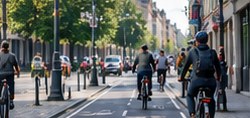
The problem: deciding without measuring
Creating a bicycle street is a deliberate policy choice. But is it working? How many cyclists use it, at what times, and do drivers respect the rules? One-off counts and residents’ complaints give an incomplete picture, and without figures it is hard to adjust course or justify the next investment.
Our approach: continuous measurement with cameras
Our AI cameras recognise cyclists, cars, pedestrians and other road users and follow how they move through the street. The system counts traffic flows, measures speed and density, and flags unsafe behaviour such as cars overtaking cyclists. No sensors in the road surface and no manual counts are needed: just clear, objective footage that is turned into data automatically.
The outcome: cycling policy built on facts
You see how each bicycle street performs by day and by hour, and how that changes after an intervention. That lets you support decisions in front of council and residents, act precisely where problems arise, and show what an investment has delivered.
How it works
-
01
Consultation
We discuss the questions you need answered and the streets and cameras involved.
-
02
Tailored plan
We draw up a measurement plan: camera positions, counting zones and the figures you want to follow.
-
03
Installation and go-live
We install or connect the cameras and integrate smoothly with your existing infrastructure.
-
04
Ongoing support
We monitor operation, keep the system up to date and deliver the data in a dashboard or through an API.
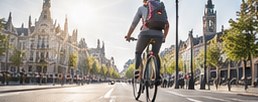
Data and privacy
Monitoring needs movements, not people.
- Faces and number plates can be blurred.
- What you receive are anonymised counts, speeds and movement patterns, not identifiable people.
- The system is designed with the GDPR as its starting point.
Frequently asked questions
What exactly does the system measure?
The number of cyclists, cars, pedestrians and other road users, peak hours, traffic speed and density, compliance with the bicycle street rules, and unsafe situations such as cars overtaking cyclists.
Do we need new infrastructure?
No. The system is entirely camera-based: no roadworks and no sensors in the road surface. Existing cameras can often be used.
Can we use our existing cameras?
Our solutions work with most existing camera systems. We assess your setup and advise on how to get the best data quality and coverage.
How do you protect road users’ privacy?
Faces can be blurred and nobody is identified: the system delivers anonymised counts and movement patterns. It is designed with the GDPR as its starting point.
What does it cost?
Pricing depends on the number of locations and the scope. You typically pay for camera integration (one-off or per location), for processing, and optionally for a dashboard or an API connection.
Measure how your bicycle streets perform
Tell us which streets you want to follow. We will draw up a measurement plan together.